AI is only as safe as your Microsoft 365 governance
TL;DR: AI adoption is accelerating, but most organizations are still unprepared because the real challenge isn’t AI itself, but the state of their Microsoft 365 governance, data quality, and permissions. To move forward safely and confidently, leaders must focus on visibility, reducing oversharing, and operationalizing governance through shared responsibility across IT and the business.
We recently hosted a private breakfast in London for senior IT leaders to discuss a question many organizations are now facing: Are we actually ready for AI—or just eager to adopt it?
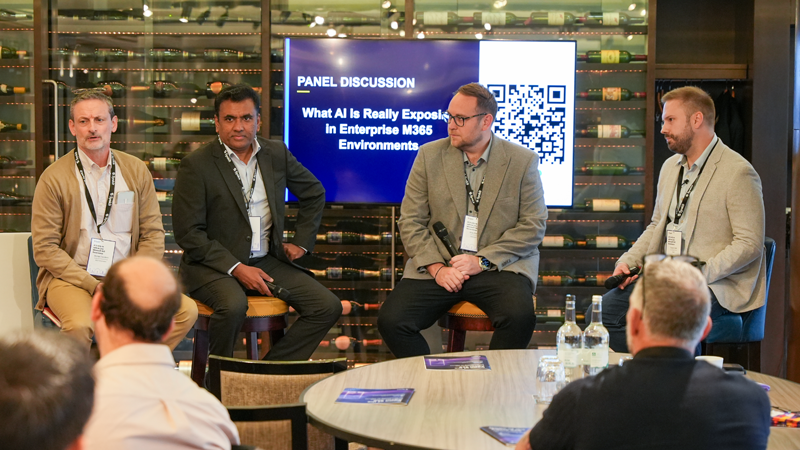
The session brought together enterprise perspectives on Microsoft 365, governance, and AI readiness. While the enthusiasm for AI, particularly Copilot, is undeniable, the discussion quickly surfaced a more sobering reality: AI is accelerating existing risks faster than most organizations can manage them.
Here are the five key takeaways that stood out.
1. AI readiness starts with Microsoft 365 (not AI tools)
A consistent theme across both the panel and peer discussions was simple: You can’t be ready for AI if your Microsoft 365 environment isn’t ready.
AI systems like Copilot don’t operate in isolation—they rely entirely on the content and permissions already in place. That means:
- Poor data quality leads to poor AI outputs
- Weak permissions lead to unintended exposure
- Unstructured environments lead to unreliable results
What was previously seen as a “known governance issue” has now become a board-level priority driven by AI adoption pressure.
2. Governance must enable AI—not delay it
A major mindset shift emerged during the discussion: Waiting for perfect governance is no longer an option.
Leaders agreed that trying to “fix everything first” creates delay and competitive risk. Instead, the more practical approach is:
- Start with minimum viable governance
- Introduce guardrails early
- Improve maturity iteratively alongside AI adoption
As one attendee put it best: “Governance should be an enabler to doing AI in a safe way—not a blocker.” This reframes governance from a control mechanism into a business accelerator.

3. Oversharing and content sprawl are the real AI risks
While AI risk is often framed around models and tools, the reality is much more grounded: The biggest risks already exist in your data. Two issues stood out clearly:
- Oversharing (too many people have access to too much content)
- Content sprawl (duplicate, stale, low-quality information)
These were reinforced both in the discussion and the session content as the top risk factors impacting AI outcomes. The implication is critical:
- AI will surface what users can already access
- It will also pull in surrounding, unintended context
- And it will do so at scale
As one participant put it: “AI is like a vacuum cleaner—it doesn’t just pick up what you point it at.”
4. Visibility and shared ownership matter more than control
One of the strongest shifts in language during the session was moving away from “control” toward:
- Visibility
- Guardrails
- Shared responsibility
Why? Because at enterprise scale:
- IT and security teams cannot manage governance alone
- They lack both the capacity and the business context needed to make decisions.
Instead, the most effective model discussed was shared governance:
- IT & Security → define guardrails, policies, and visibility
- Business owners → validate access, clean content, provide context
- End users → take ownership of how data is used
This combination—guardrails + context—is what enables AI to be deployed safely and confidently.

5. AI is exposing organisational gaps—not just technical ones
Beyond technology, the discussion highlighted deeper structural challenges:
- Unclear ownership of AI initiatives
- AI defaulting to IT instead of the business
- Lack of accountability at the use-case level
- Change management and user adoption gaps
At the same time, trends like shadow AI and citizen development are growing—not as problems to eliminate, but as signals: They reveal what the business actually needs from AI.
Organisations that succeed will be those that:
- Align ownership with business outcomes
- Invest heavily in education and change management
- Treat governance as a people problem—not just a technical one
What to do next: From insight to action
The discussion closed on a clear note: most organisations don’t need more strategy—they need a starting point.
Based on the themes from the session, here’s where to focus:
1. Assess your current exposure
- Identify oversharing across SharePoint, Teams, and OneDrive
- Understand where sensitive data is accessible beyond intent
- Map visibility gaps before rolling out AI broadly
2. Establish minimum viable governance
- Define baseline controls for permissions, sharing, and ownership
- Introduce guardrails—not perfect policies
3. Fix the fundamentals that AI depends on
Focus on:
- Permissions and ownership
- Lifecycle management
- Content quality
4. Move to a shared governance model
- Involve business owners in access and content decisions
- Combine central guardrails with business context
5. Make governance operational
The real challenge isn’t defining governance—it’s making it continuous and scalable. That means governance must be:
- Visible (clear where risks exist)
- Actionable (issues can be fixed at scale)
- Collaborative (business users provide context)
Solutions like Syskit Point help operationalise this by:
- Providing tenant-wide visibility
- Reducing oversharing and content sprawl
- Enabling shared governance workflows across IT and the business
Final thought: AI doesn’t introduce chaos—it reveals it.
Success with AI depends on building the foundation to move safely, confidently, and at scale.